
Cosmetics · research
HonestActives
Real science on cosmetic actives. No is an answer too.
HonestActives is a research platform for companies that make and sell cosmetic actives, developed by Bondconsulting Organization. It starts from an active, a plant, a gene, a claim or a medical paper and leads to what is known, the tests worth buying and a technical dossier already started.
From the need to the solution
Need
A company sells an active with a long history, positioned as an antioxidant. The market asks for new claims and a new molecule takes years. Meanwhile the customer wants to know what stands behind it: the mechanism, the tests, the technical file. The question is whether the active already in the range supports a new claim, and what it costs to show it.
How it was worked out
Before any model, the knowledge was put in order: what is measured, what is predicted, what is only a trade name. The result is a ladder of evidence tiers, and the rule that a prediction never moves up a rung.
Data integration
Affinity measures on human targets (BindingDB, 2,477,376 measures on 3,376 targets), the CosIng catalogue (33,666 ingredients), compounds of botanical origin (LOTUS, 661,004 compound-organism links), EFSA's evaluations of 7,890 substances, 263 IFRA Standards, patents and literature, joined by identifier and never by name.
AI
A language model reads a medical paper and proposes its cosmetic reading, or says in one sentence why there is none. It asks the questions and does not give the answers: those are your team's. The numbers, the evidence tiers and the verdicts come from fixed rules, and the model does not touch them.
Solution
A web app on a server dedicated to your company. In one session: the concept, the candidate molecules on measured data, the first test to buy with its method and controls, the public safety records and the technical dossier of the ingredient already started.
- Time saved
- The reading, the lookups and the first draft of the documents take one session, not weeks, and you buy the test the data points to, not the ones it rules out.
- Knowledge added
- New uses for actives you already make, and the certainty of where the evidence stops: an absence is stated as an absence.
Without the knowledge matrix, AI does nothing: here it comes last, on top of data put in order.
HonestActives is built for companies that make and sell cosmetic actives. You start from an active, a plant, a gene, a claim or a medical paper. You leave with what is known, the tests worth buying and a technical dossier already started.
For each active you read what it does to seven skin cell models, with the evidence tier beside every line. Where the evidence is missing, the app says so and names the experiment that would settle it.
What it does
- Ten ways in: plant, alga, fungus, gene, formula, molecule, INCI, peptide, vesicles, concept
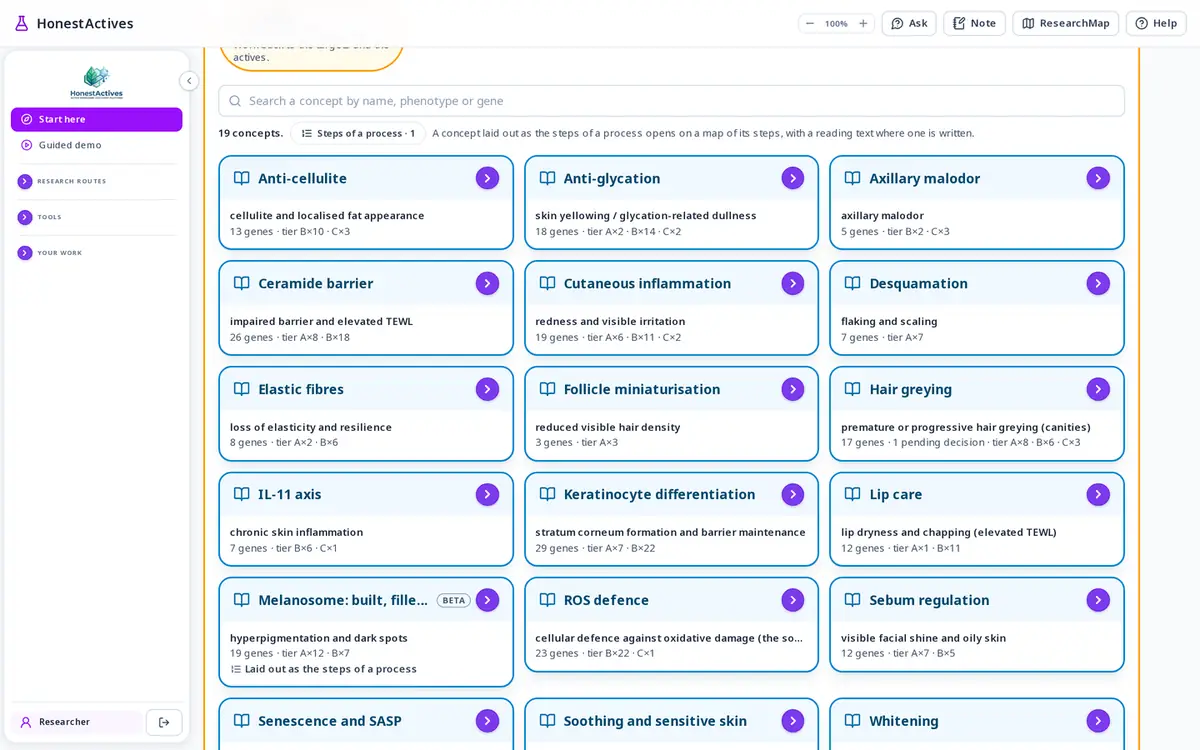
- Concepts: from the claim to its genes, to the measured molecules, to the plants and peptides that carry them
- From a medical paper to a cosmetic concept, with the questions your team answers
- Seven skin cell models side by side, with a verdict decided by rules
- Safety and regulatory records: EFSA, Annex III, IFRA Standards, skin permeation
- Claims and studies: the protocol needed to support them
- Scientific Dossier of the project, in PDF and in Word
- Technical Dossier of the ingredient in Word, with the known fields already filled
- 19
- concepts ready: from the claim to genes, molecules and plants
- 228
- fields in the technical dossier of an ingredient, the known ones already filled
- 7
- skin cell models side by side
Figures from the application's archive, October 2026.
Explore the interactive tour
From a plant, molecule, gene or cosmetic idea to the Virtual Cell Lab, claims and dossier, plus the three peptide doors and the custom service on your own peptides. The tour opens and explains the panels, with English, French, Italian, Spanish, Brazilian Portuguese, German or Japanese narration. No sign-in required.
A demonstration with dated example results, not a new analysis of your product.
A case: a new positioning for an active already in the range
A real session of the application, run on 10 October 2026. It is not a customer's story: it is what the app answered, step by step.
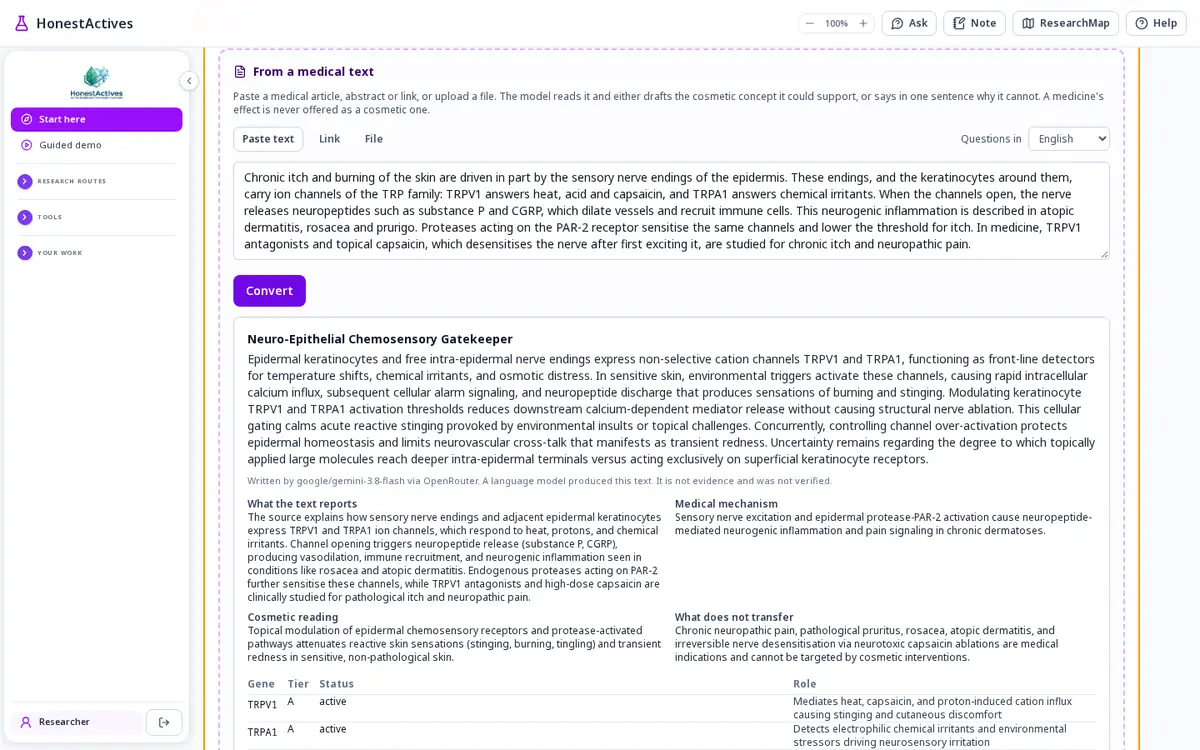
A medical paper becomes a concept
A medical summary on chronic itch and the channels that switch it on in the nerves of the skin. The app proposes the cosmetic concept, writes what does not transfer from medicine to cosmetics, and asks the team 5 questions.
The concept finds the molecules
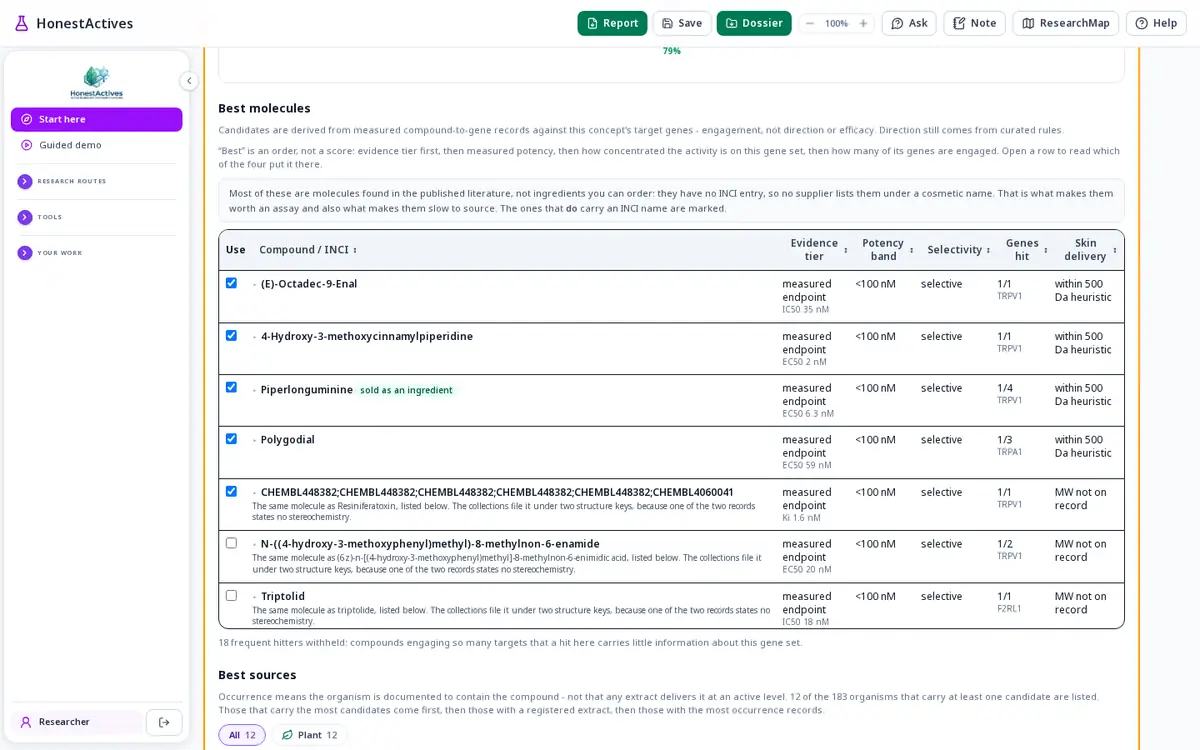
Soothing and sensitive skin: 5 genes, 4 of them targets. Against them the app lists 14 molecules with a measured value and 183 organisms that carry at least one. The first is the chilli pepper, Capsicum annuum.
One candidate is an active already on sale
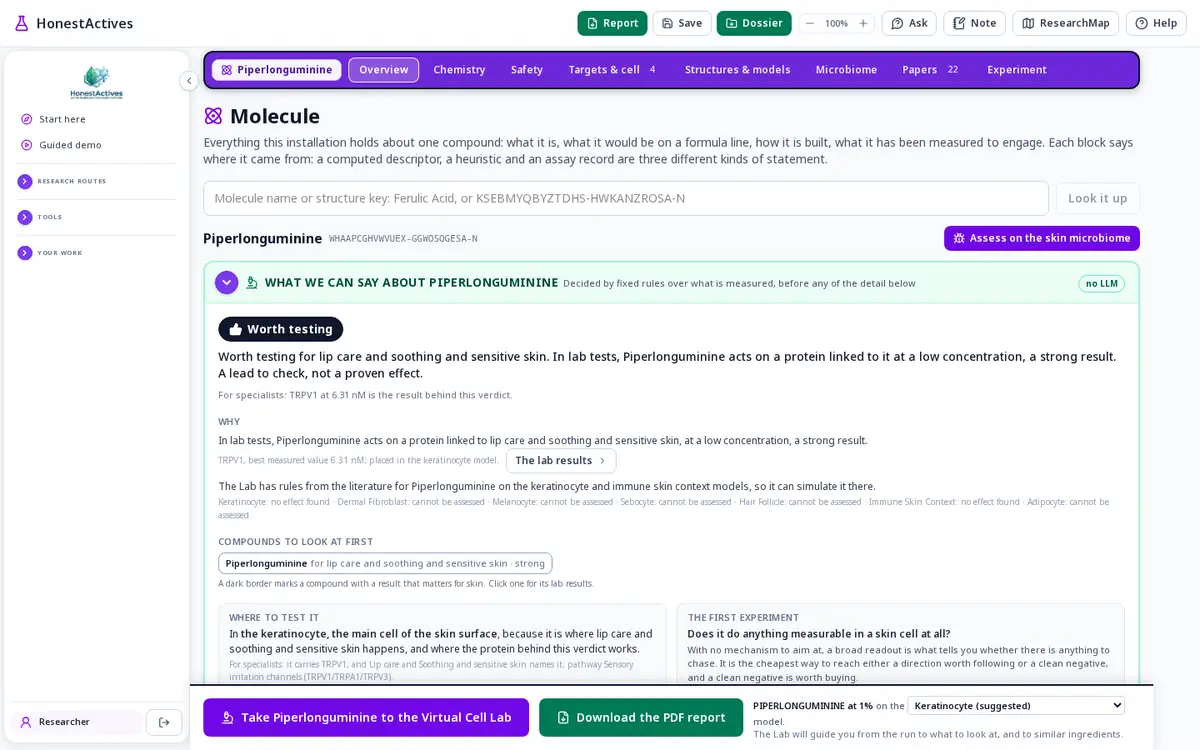
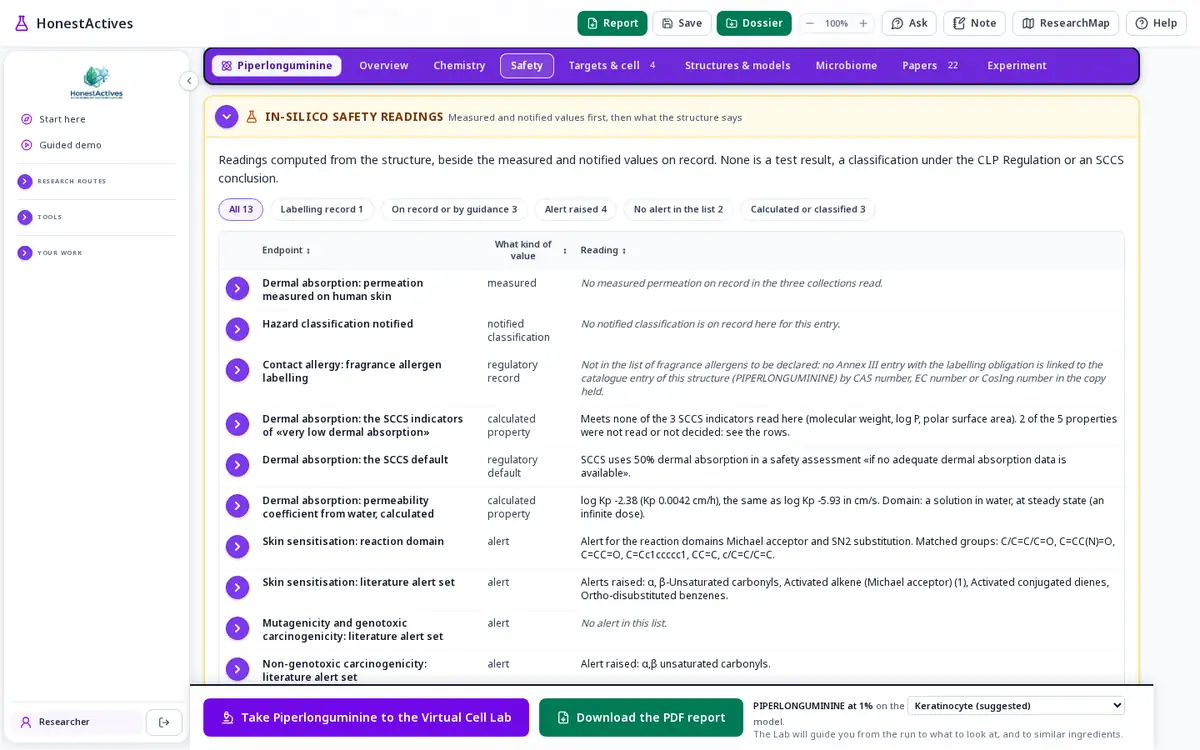
Among the candidates is piperlonguminine, registered in CosIng as an antimicrobial, an antioxidant and a skin conditioner. Its page gives a verdict decided by rules: worth a test for sensitive skin, because it acts on TRPV1 at 6.31 nanomolar. And it says where the evidence stops: in the keratinocyte model it finds no effect.
The first test, with its criterion
The app names the experiment that would settle it: model, method, 4 reagents, 4 controls, the acceptance criterion and the error that most often spoils that measurement.
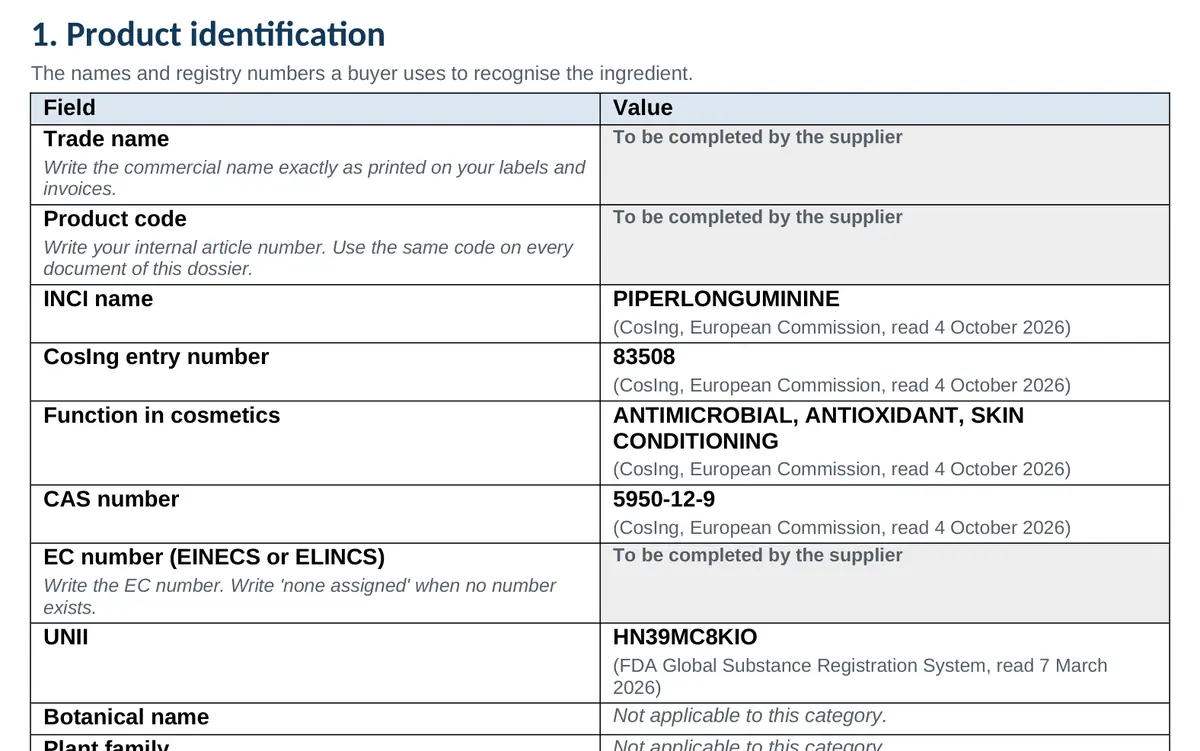
The technical dossier is already started
31 pages in Word: 17 fields taken from public records with their source, 18 computed and to be verified, 137 left to the company with an instruction each.
Screens
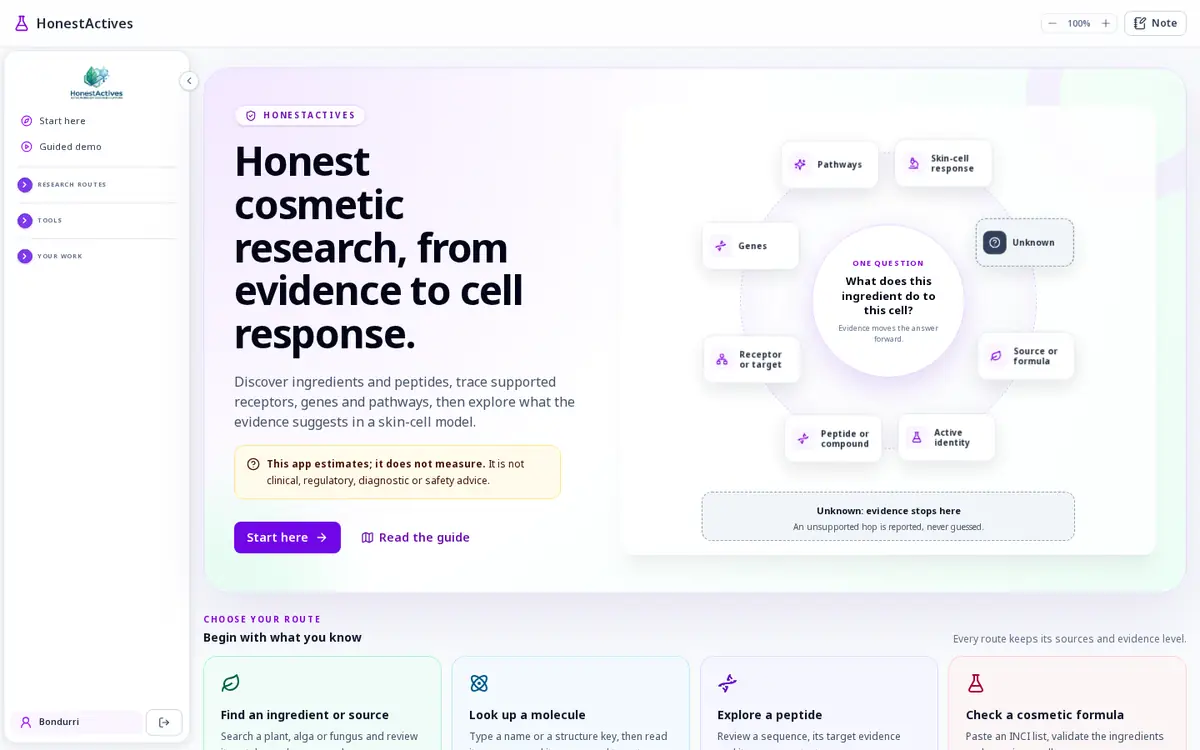
Use the arrows to move through them.
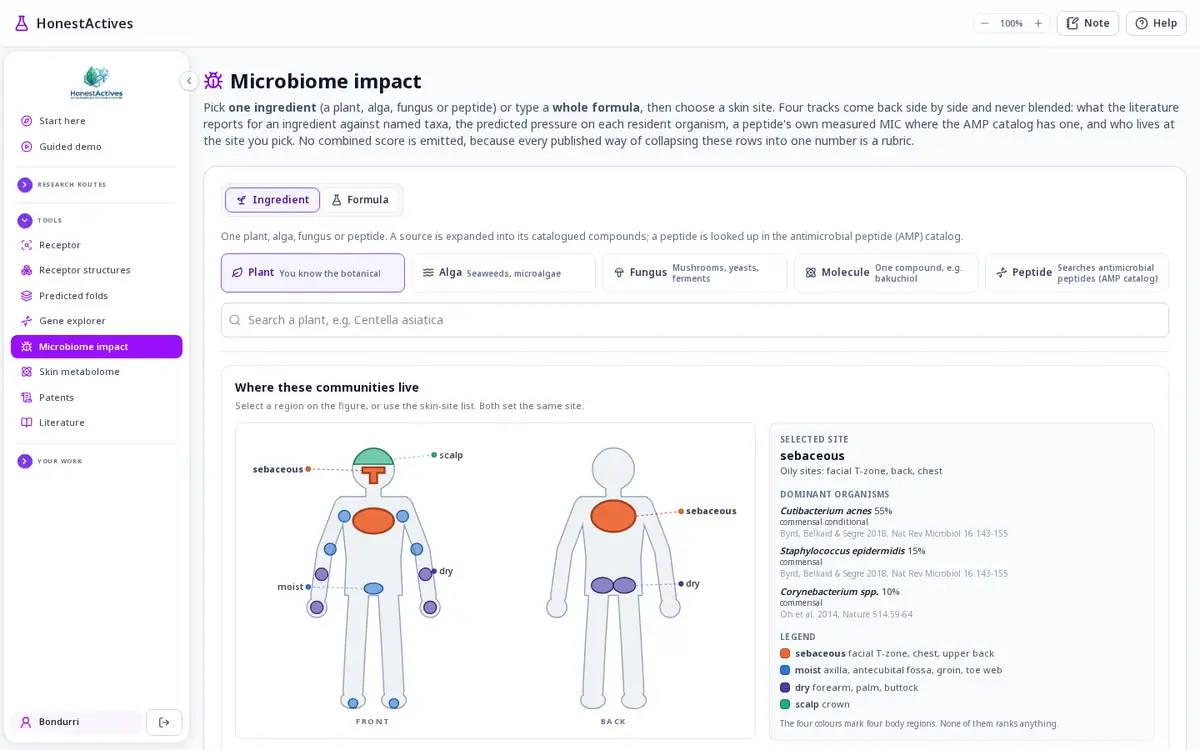
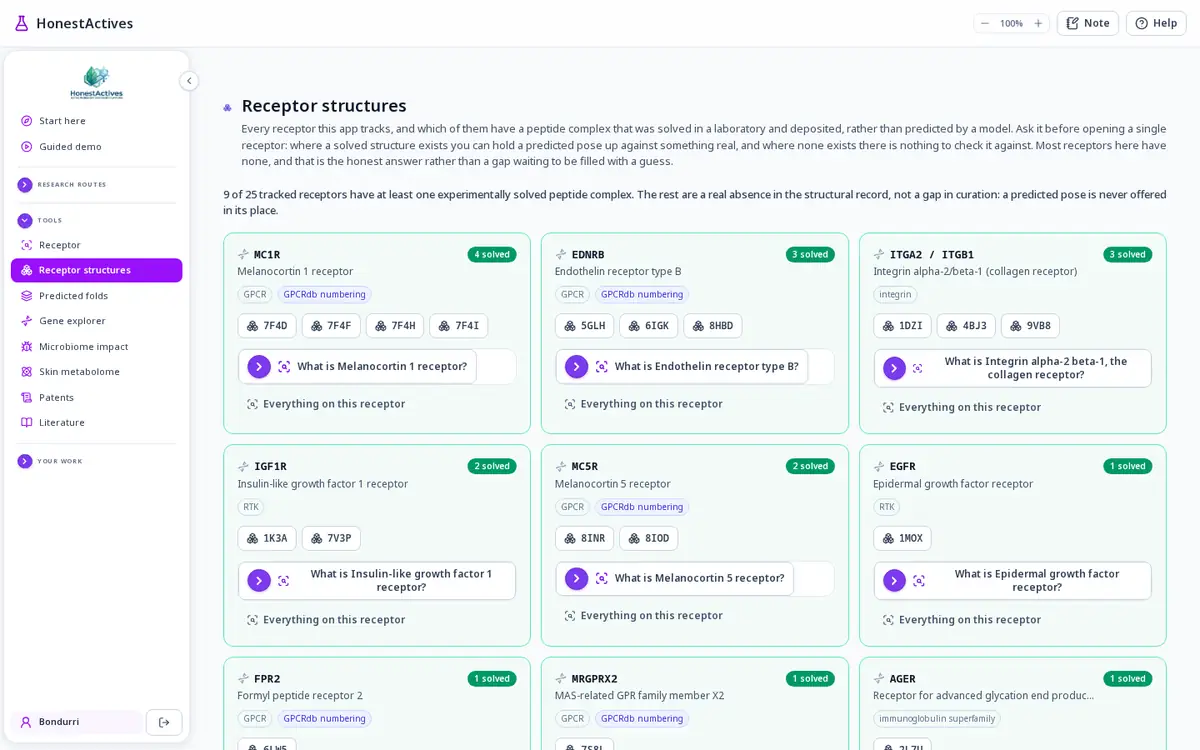
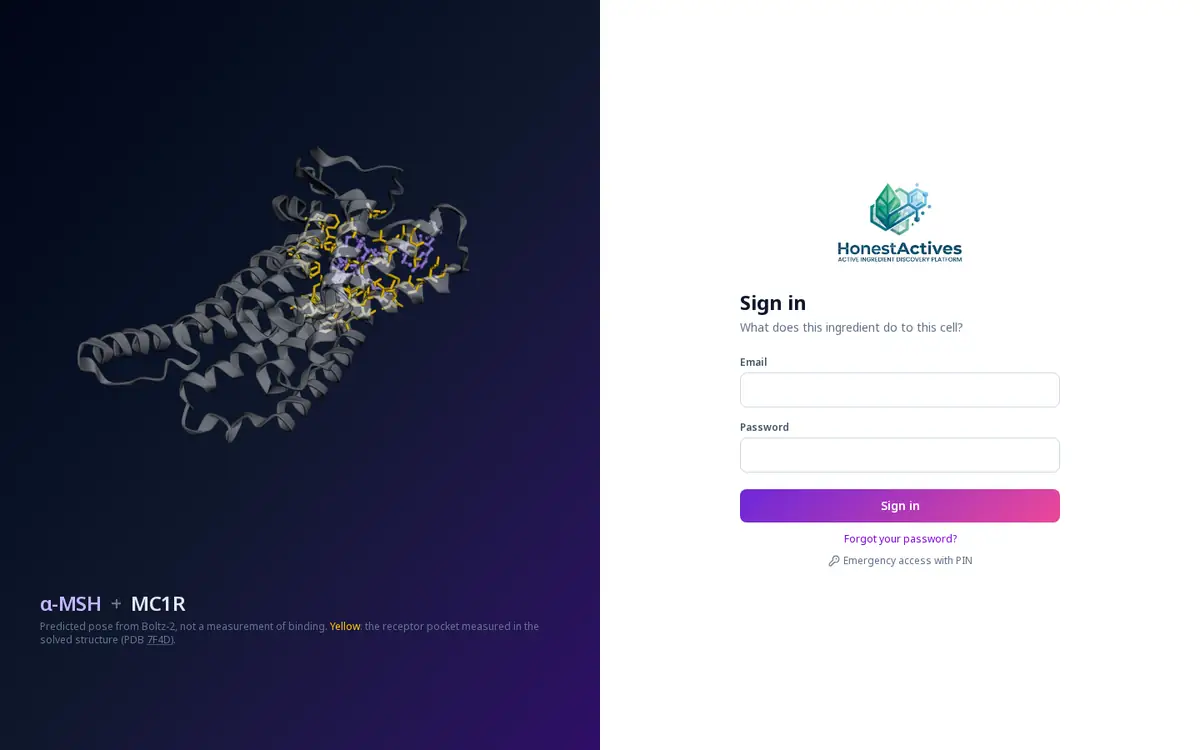
What it says and what it does not
The app estimates, it does not measure. It ranks candidates and names the experiment to run. It does not replace binding assays, cell-response tests, safety testing or regulatory assessment.
Every result carries the evidence tier it reached. A structure predicted by the model never earns an evidence tier, and a short sequence is not promoted to evidence of binding.
Where no structural or literature basis exists, the app says so. That answer saves the spend, and it keeps out of your documentation a claim a customer's toxicologist would take apart.
The safety and regulatory records are public registers, shown as published and with their source. They are not a safety assessment.
How you buy it
Annual licence
One licence for your company, renewed each year. Every user at the approved company email domain is authorised.
Dedicated server
The service runs on a machine that works for you alone. Nothing is shared with another customer: not the machine, not the database, not the projects.
Full control
Your administrator invites and removes users, sets roles, starts the data refreshes, chooses the language models and uploads the logo.
Unlimited use
No limit on analyses, searches, projects, reports and dossiers. The only meter is the language model: 250 dollars a year are included, then you connect your own OpenRouter key.
Download the brochure
About forty pages: what the app does for a company that makes actives, the screens, the case step by step and the offer. In English and in French.
Frequently asked questions
What is HonestActives?
HonestActives is a research platform for cosmetic actives. It starts from an active, a plant, a gene, a claim or a medical paper and shows what is known, across seven skin cell models, with the evidence tier stated line by line. Where the evidence is missing, it names the experiment that would settle it.
Who is HonestActives for?
First of all for companies that make and sell cosmetic actives: to find a new use for an active already in the range, to start from the claim the market asks for, to decide which tests to buy and to hand the customer a dossier. It also serves the formulator and the claim owner, who need to know what stands behind an active.
What are the concepts in HonestActives?
A concept is a claim written the way a laboratory tests it: the genes behind the effect, each with its role and its source. From the concept the app finds the molecules with a measured value against those genes, and then the plants and peptides that carry them. There are 19 hand-curated concepts.
Can HonestActives start from a medical paper?
Yes. You paste a medical text, a link or a file, in any language. A language model proposes its cosmetic reading, or says in one sentence why there is none, and writes what must not be transferred from medicine to cosmetics. Before saving, the app asks up to five questions: the team's answers decide, not the model.
Does HonestActives measure the efficacy of a cosmetic active?
No. HonestActives estimates, it does not measure. It ranks candidates and names the experiment to run first. It does not replace binding assays, cell-response tests, safety testing or regulatory assessment, and nothing it shows is clinical or regulatory advice.
How does it help substantiate a cosmetic claim?
Regulation (EU) 655/2013 asks for adequate, verifiable evidence behind every claim. HonestActives places a claim on a four-rung ladder and reaches three of them: direction, hypothesis, literature support. For each it names the study needed: model, method, controls and acceptance criterion. The fourth rung, the finished-product study, belongs to the laboratory.
What is the HonestActives technical dossier?
It is the technical file of a cosmetic ingredient, in Word, in the order a customer expects: identity, origin, composition, specification, regulatory status, safety, efficacy, declarations. The app fills the fields a public record knows, with the source, marks apart the values it computed, and leaves the others to the maker with an instruction each. It does not write the safety data sheet and it signs nothing.
What data does HonestActives start from?
From public sources named line by line: affinity measures on human targets (BindingDB), ingredients catalogued by EU CosIng, compounds of botanical origin (LOTUS), EFSA's evaluations, the IFRA Standards, the entries of Annex III and predicted structures of peptide and receptor complexes. Every record is joined by identifier and never by name.
What happens when there is no evidence?
The app says so. Where no structural or literature basis exists, HonestActives states the absence and does not offer a result anyway. A structure predicted by the model never earns an evidence tier, and a missing safety record is never read as a clean bill.
How is HonestActives sold?
As an annual licence for the company. The service runs on a dedicated server, not shared with other customers, and the company's administrator controls users, roles, data refreshes and language models. Use is unlimited: the only meter is the language model, with 250 dollars a year included and then the customer's own OpenRouter key.
How can I try HonestActives?
Through a demo on request. Fill in the form on bondconsulting.it with your name, company and work email, and Bondconsulting Organization replies in person with the demo credentials. The HonestActives page also offers the brochure, in English or in French, in exchange for an email address.
Can I use HonestActives to develop a new cosmetic product?
Yes, at the stage where you choose the active and decide what to test. You start from a plant, a molecule, a gene or the claim the market is asking for, and you end with a short list of candidates, each carrying its evidence tier and the assay that would settle it. It does not formulate the product and does not replace the laboratory: it exists so that you buy six assays instead of a hundred and forty.
What does HonestActives tell me about plant actives?
You start from the organism — a plant, an alga, a bacterium — and see the catalogued actives it carries, each with its chemical class and evidence tier. From there you reach the molecular targets those actives engage and the seven skin cell models, to see which ones look like candidates and which show an adverse effect instead.
What can I see about a single plant active?
Its chemical identity with the public identifiers, the organisms that carry it, the targets where an affinity has been measured and those only predicted — kept apart — the cell pathways it touches, the published work that names it, and the regulatory status of the ingredient. Every line says where it came from, and an identifier opens the public record rather than being a string to copy into a search box.
Can HonestActives work on a peptide from scratch?
Yes. You type a sequence, or start from the target or the cosmetic objective, or pick an organism and cut its proteome with the enzymes you intend to use, to see which fragments come out. The sequence is read conservatively: lipidation, amidation, metal complexes and D residues change the molecule more than the one-letter sequence suggests, and where they are not stated the app says so instead of guessing.
For a peptide, which assay is worth buying?
This is the question the app is built to answer: among the possible bench tests it names the one with the highest chance of succeeding, with the model, the method, the controls, the acceptance criterion and the pitfall that most often makes that measurement mean less than it appears. Beside it, what the peptide is for and which sentence would become available if the assay succeeded — or that there is no basis for either, which is as useful an answer as the others.
What is the difference between the in silico evaluation and in vitro testing?
The app estimates; it does not measure. In silico it brings together what others have already measured, what a model predicts and what the structure suggests, and keeps the three apart and labelled. That is how you choose what to take in vitro, and with which experimental design. The bench stays the bench: no number computed here replaces an assay, and none of them counts as evidence supporting a claim.
Are the answers written by an artificial intelligence?
No. The process rests on real science: public databases, published measurements, curation done by people. Scores and verdicts are computed by declared rules, and the same data always gives the same answer. A language model comes in afterwards and in a defined role: it summarises the facts the engine has already computed, helps check whether a pathway is plausible, and proposes the cosmetic reading of a medical text. It cannot create a fact, an evidence tier, a direction or a number, and it never decides. Artificial intelligence was also used to build and to check the software itself: that is a different thing from the scientific content, and the two are not mixed.
What happens when the answer is no?
It is said out loud. "We looked and there is nothing here" is a full answer, and often the most valuable one: it saves the assay and the budget of someone weighing an active that a supplier is promising. There are three possible answers — the claim can be supported, it cannot be supported yet but there is a mechanism worth proposing with the experiment that would settle it, or there is no basis at all — and the app never bends the result to reach the first.
Ask to see the applications at work.
The live demo is requested through the form: we reply in person with the credentials.
